

Setup Guidelines
Building a reliable and accurate immersive monitoring environment requires careful planning of speaker placement, system calibration, and connectivity. The following guidelines provide practical recommendations to help you get the most out of ARC X.
Speakers Positioning
Accurate speaker placement is the foundation of any immersive system. Industry-standard layouts, defined by Dolby, provide precise positioning guidelines for Dolby Atmos configurations.
Refer to the official layout specifications available on the Dolby website to determine the correct angles, distances, and speaker elevations for your setup.
While these specifications represent the ideal configuration, real-world environments often introduce constraints such as doors, windows, furniture, or structural limitations. In these cases, it is acceptable to slightly adjust speaker positions to accommodate the room, as long as overall spatial balance and symmetry are preserved as much as possible.
Another important aspect to consider is the proximity of speakers to walls. Placing speakers closer to walls increases low-frequency energy due to acoustic coupling. When using ARC X, this low-frequency buildup is measured and compensated during calibration. The attenuation applied by the correction effectively translates into additional headroom, allowing the system to achieve higher clean output levels (SPL) without distortion.
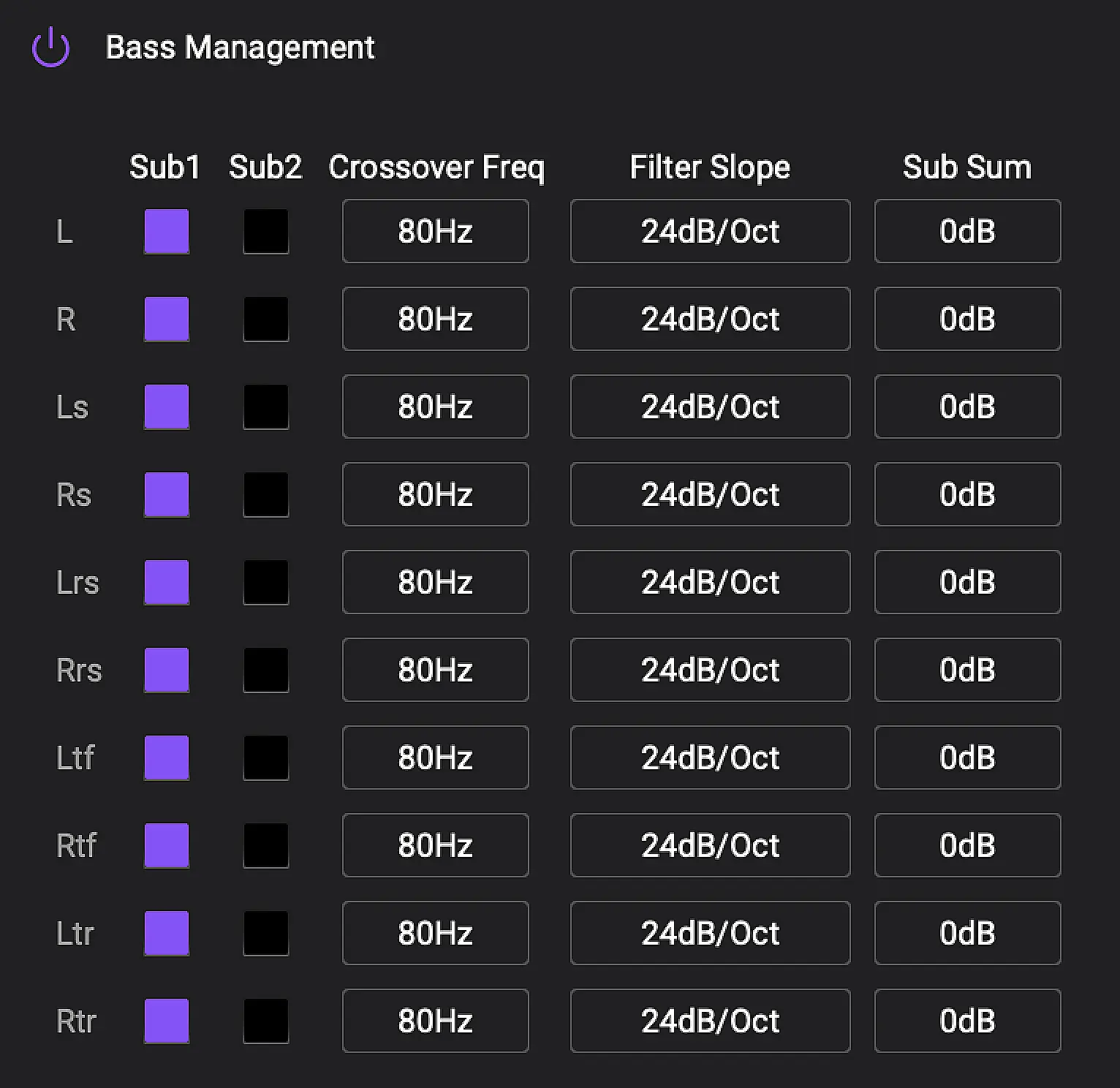
Bass Management
Bass management is a system configuration technique used to redirect low-frequency content from multiple speakers to one or more subwoofers.
This is particularly useful when satellite speakers cannot accurately reproduce low frequencies or are unable to deliver sufficient SPL in the low-frequency range. In these cases, redirecting low-frequency content to a subwoofer improves headroom and overall system performance.
Bass management must be configured externally, either in the audio interface control software or within the DAW. ARC X processes each speaker individually and does not handle audio routing, so it cannot perform bass management. For this reason, any bass management setup must be implemented earlier in the signal chain.
When using ARC X, bass management must be disabled during the measurement process. This ensures that ARC X captures the true, unprocessed response of each individual speaker and the room.
Once the calibration process is complete, bass management can be re-enabled if required by your monitoring workflow or playback system.
USB Tiers and Hub Depth
USB devices are organised in a hierarchical structure known as a tiered topology. In this structure, the computer acts as the USB host, and each USB hub added between the computer and a device creates an additional tier in the connection path.
According to the USB specification, a connection can include a maximum of seven tiers, including the host and the final device. In practical terms, this means that no more than five USB hubs can exist in the path between the computer and any device. However, many computers internally use USB hubs to provide multiple external ports. As a result, the USB port you connect to may already occupy one or more tiers before any external hubs are added.
For this reason, to ensure reliable operation across a wide range of systems, IK Multimedia recommends using no more than three USB hubs in cascade between the computer and any IK device.
Considerations for Immersive Systems
Surround and Dolby Atmos systems include multiple USB-connected devices positioned quite far from the computer. When building larger monitoring systems, it is important to design the USB topology so that it remains within the supported tier limits.
For example, a 7.1.4 immersive monitoring system includes 11 speakers plus a subwoofer, resulting in many USB devices connected to the same host. To maintain a stable configuration, it is recommended to distribute devices across multiple USB hubs connected directly to the computer, rather than creating long chains of hubs. If hub chaining is required, ensure that no more than three hubs are connected in series between the computer and the final device.
IMPORTANT NOTE - IK Multimedia devices used with ARC X do not draw power from the USB connection, as USB is used only for control and communication. For this reason, externally powered USB hubs are not required, and standard USB hubs can be used to connect multiple devices.


